4 cups all-purpose white flour
3 tablespoons granulated sugar
2 teaspoons baking powder
2 teaspoons baking soda
1/4 teaspoon salt
2 sticks (1 cup) unsalted butter, cut into bits
3 tablespoons freshly grated orange zest (from about 2 navel oranges)
1 1/2 cups dried currants
1 cup plus 2 tablespoons well-shaken buttermilk
2 large eggs
1/4 cup granulated raw sugar (turbinado or Demerara)
preparation
In a bowl of a standing mixer fitted with paddle attachment stir together flour, granulated sugar, baking powder, baking soda, and salt. Add butter and zest and beat until mixture resembles coarse meal. Beat in currants. In a bowl whisk together buttermilk and eggs and add to flour mixture, beating just until a dough forms.
Preheat oven to 350°F. and line 2 baking sheets with parchment paper. On each sheet arrange six 1/2-cup mounds of dough about 1 inch apart. Sprinkle mounds with raw sugar and chill 15 minutes.
Bake scones in upper and lower thirds of oven, switching position of sheets half-way through baking, until light brown, about 20 minutes.
Showing posts with label Bread. Show all posts
Showing posts with label Bread. Show all posts
Saturday, July 3, 2010

Monday, May 24, 2010
Martha's perfect pizza

Makes two round pizzas, 12 to 14 inches in diameter
- 1 cup warm water (100 degrees to 110 degrees)
- 1/4 teaspoon sugar
- 1 package active dry yeast
- 2 3/4 cups to 3 1/4 cups all-purpose flour, plus more for dusting
- 1 teaspoon salt
- Coarse-grain cornmeal, for dusting
- 3 1/2 teaspoons olive oil, plus more for bowl
- Pizza Sauce
- 12 ounces fresh mozzarella cheese, thinly sliced
Directions
- Heat the oven to 500 degrees, with a 16-inch diameter pizza stone placed on lowest shelf position, for at least 30 minutes.
- Pour warm water into a small bowl. Add sugar, and sprinkle in yeast. Using a fork, stir the mixture until yeast is dissolved and water has turned a tan color. Let yeast stand until foamy, about 10 minutes. In a food processor, use blade to combine the 2 3/4 cups flour and salt, and pulse three to four times. Add yeast mixture and 1 1/2 tablespoons olive oil. Pulse until the dough comes together, adding more flour as needed until dough is smooth, not tacky, when squeezed. Transfer to clean surface; knead four or five turns into a ball.
- Brush the inside of a medium bowl with olive oil, and place the dough in the bowl, smooth side up. Cover tightly with plastic wrap, and place in a warm spot until doubled in size, about 40 minutes. Remove plastic wrap, and press your fist into the center of the dough to punch it down. Fold the dough back onto itself four or five times. Turn dough over, folded-side down, cover with plastic wrap, and return to the warm spot to rise again until the dough has doubled in size, about 30 minutes.
- Punch down the dough, and transfer to a clean surface. Using a bench scraper or a sharp knife, divide the dough in half, and knead each half four or five turns into a ball. Place one of the dough balls back in the oiled bowl, and cover with plastic wrap. Lightly flour a clean surface, place the remaining dough ball on top, pat into a flattened circle, cover lightly with plastic wrap, and let rest 5 minutes. Using your fingers, begin to flatten and push the dough evenly out from the center until it measures about 7 to 8 inches in diameter. Do not press the dough all the way to the edges. Leave a slightly raised border, about a half-inch wide, around entire circumference of pizza dough.
- Sprinkle cornmeal all over the surface of a pizza peel, and set aside. Lift the dough off the surface, and center it on top of your fists. Hold your fists about 1 to 2 inches apart. Begin to rotate and stretch the dough, moving your fists until they are 6 to 8 inches apart and the dough is several inches larger. Then place your fists under the inside of the outer edge, and continue to stretch the dough a little at a time until it reaches about 12 inches in diameter. The dough will drape down over your forearms. At this stage, it is important to keep your fists along the inside of the outer edge and watch that the dough does not get too thin or tear in the center. At the same time, make sure to maintain the slightly raised border on the edges. The dough is surprisingly resilient and will not tear if this step is done carefully and slowly.
- Arrange the pizza dough into a circle on top of the cornmeal-dusted peel. Leaving the raised edge uncovered, pour 9 tablespoons of the pizza sauce onto the dough. Using the back of a tablespoon, evenly spread the sauce leaving a half-inch border of dough uncovered. Arrange half of the mozzarella slices on top of the sauce.
- Lift the pizza peel and, using a slight jerking motion, slide the pizza about one inch back and forth on the peel to loosen it. Slightly tilt the peel, and place the front tip of peel on the back side of the stone. Slide the pizza off the peel, centering it on the stone. Bake until the crust is golden brown and crisp on the edges and the bottom, 10 to 12 minutes, turning the pizza halfway through baking. While first pizza is baking, shape and assemble a second pizza using remaining dough. Using tongs, lift the edge of the first pizza, and slide the peel all the way under to remove it from the oven. Using a pizza wheel, slice the pizza into eight pieces, and serve immediately.
Saturday, April 10, 2010
Paper-Baked Cinnamon Rolls
1/2 cup sugar
1/2 tsp ground cinnamon
pinch each cloves, nutmeg and allspice
1 3/4 cups flour
1 3/4 tsp baking powder
1/2 cup pitted and chopped dates
1/2 cup whipping cream
1/2 cup milk
2 Tbsp butter, melted for brushing
Preheat oven to 350F.
Combine the sugar, cinnamon, cloves, nutmeg and allspice and set aside.
Place the flour, baking powder and dates in a bowl and stir to combine. Make a well in the center and gradually add the cream and milk, stirring, until a soft dough forms.
Turn out onto a lightly floured surface and knead until smooth and elastic. Roll our to 12" x 15". Brush with butter and sprinkle with the sugar mixture, reserving 1 Tbsp. Roll up the dough to enclose and slice into 8 pieces. Place the dough into eight 1/2 cup capacity muffin tins lined with parchment paper. Brush with butter and sprinkle with the reserved sugar. Bake for 25 minutes or until golden. Makes 8
Monday, February 22, 2010
Jalapeno Corn Muffins
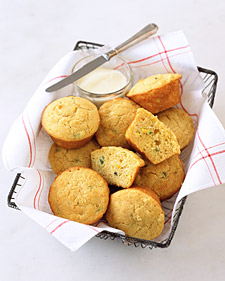
Serves 4
- 8 tablespoons (1 stick) unsalted butter, plus more for tin, melted
- 3/4 cup nonfat buttermilk
- 2 large eggs
- 1/2 cup sour cream
- 1 cup yellow cornmeal
- 1 cup all-purpose flour
- 1/2 cup packed light-brown sugar
- 2 tablespoons baking powder
- 1 teaspoon coarse salt
- 2 jalapenos, seeded and finely chopped
- 1/4 cup plus 2 tablespoons fresh or frozen (thawed) corn kernels
- Unsalted butter, for serving
Directions
- Preheat oven to 375 degrees. Brush the cups of a standard 12-cup muffin tin with melted butter, and set aside. Whisk together buttermilk, eggs, and sour cream in a medium bowl until combined, and set aside. Whisk together cornmeal, flour, sugar, baking powder, salt, jalapenos, and corn in a large bowl until combined.
- With a rubber spatula, fold buttermilk mixture into cornmeal mixture until well combined. Fold in melted butter. Divide batter among muffin cups, filling each three-quarters full. Bake until a cake tester inserted into centers comes out clean, about 25 minutes. Let muffins cool in tin 5 minutes. Turn out into a basket or bowl lined with a clean kitchen towel; cover to keep warm. Serve with butter.
Friday, June 12, 2009
Soft Pretzels

Makes 12
2 1/4 teaspoons dry active yeast (1/4 ounce)
1/4 teaspoon coarse salt
2 teaspoons sugar
1 cup warm water
3 cups all-purpose flour, plus more for surface
1/8 teaspoon cayenne pepper
2 tablespoons unsalted butter, softened
Vegetable oil, for baking sheets
3 tablespoons baking soda
1 tablespoon pretzel salt
Assorted mustards, for serving
Directions
Mix yeast, coarse salt, sugar, and warm water in a small bowl, whisking until sugar dissolves. Let stand until foamy, about 5 minutes.
Mix flour and cayenne in a large bowl. Using a pastry cutter or your fingers, cut butter into flour until mixture resembles coarse crumbs.
Slowly pour yeast mixture over flour mixture, stirring to combine. Using your hands, gather dough together. Turn dough out onto a lightly floured surface, and knead until it is no longer sticky, about 5 minutes. Cover with plastic, and let rise for 30 minutes.
Cut dough into 12 pieces, and roll each into an 18-inch rope. Form a U shape with 1 rope, and twist ends together twice. Fold twisted portion backward along center of U shape to form a circle, then gently press ends of rope onto dough to seal. Transfer to an oiled baking sheet, and repeat. Let rise for 20 minutes.
Preheat oven to 475 degrees. Bring a large pot of water to a boil, and add baking soda. Boil pretzels in batches until puffed and slightly shiny, 1 to 2 minutes per side. Transfer to wire racks to drain. Return to baking sheet, sprinkle with pretzel salt, and bake until golden brown and cooked through, about 15 minutes. Pretzels will keep, uncovered, at room temperature for up to 12 hours. Rewarm in a 250-degree oven if desired, and serve with mustards.
Thursday, June 4, 2009
Raspberry-Rhubarb Turnovers

Makes 8
All-purpose flour, for dusting
1 pound store-bought or homemade Puff Pastry
1/2 cup sugar
1/2 vanilla bean, scraped
6 ounces rhubarb, stalk split into quarters and chopped into 1/4-inch pieces (about 1 1/2 cups)
Pinch salt
2 tablespoons cornstarch
2 teaspoons lemon juice
1 teaspoon lemon zest
16 raspberries
1 large egg yolk
1 tablespoon heavy cream
Fine sanding sugar, for sprinkling
Directions
Line a baking sheet with parchment paper; set aside. On a lightly floured work surface, roll out puff pastry dough to a 17 1/2-by-9 1/2-inch rectangle, about 1/8 inch thick. Using a dry pastry brush, sweep off excess flour. Using a pastry cutter or pizza wheel, trim to a 16-by-8-inch rectangle. Cut out eight 4-inch squares. Place squares on prepared baking sheet; cover with plastic wrap and chill until firm, at least 1 hour or up to 8 hours.
In a small bowl, mix together sugar and vanilla bean seeds until well combined.
Transfer to a medium bowl along with rhubarb, salt, cornstarch, lemon juice and zest; mix until well combined. Gently fold in raspberries. Let filling stand until juicy.
In a small bowl, whisk together egg yolk and cream; set egg wash aside. Stir filling and strain, discarding excess liquid, and divide equally among the pastry squares, placing it in the center. Brush edges with egg wash. Fold dough diagonally over filling to form a triangle, and press to seal. If desired, crimp the edges using the floured tines of a fork. Place filled turnovers on a baking sheet, covered with plastic wrap, and freeze until firm, 20 to 30 minutes. The filled turnovers can be frozen for up to 3 weeks; no need to thaw before proceeding.
Preheat oven to 375 degrees. Brush tops of turnovers with egg wash, being careful not to let it drip over the edges, as this will prevent even puffing. Sprinkle generously with sanding sugar, and bake, rotating sheet halfway through, until turnovers are puffed and deep golden, 25 to 35 minutes. Using a thin metal spatula, immediately transfer turnovers to a wire rack to cool. They are best eaten the same day they are baked.
Thursday, May 28, 2009
Pecan Brown-Butter Bread

Makes 1 9-inch loaf
1/2 cup (1 stick) plus 2 tablespoons (1/4 stick) unsalted butter, divided
2 cups shelled pecans, divided
2 cups flour plus 1 1/2 teaspoons, divided
1 1/3 cups packed brown sugar, divided
2 large eggs
1/2 teaspoon almond or vanilla extract
1 teaspoon baking powder
1 teaspoon baking soda
1/2 teaspoon salt
1 cup sour cream
1. Heat the oven to 325 degrees. Melt one-half cup butter in a heavy skillet over medium heat. After it melts, continue to cook, whisking until it turns nut brown, about 8 minutes. Remove the browned butter from the heat and cool, then refrigerate until it solidifies, about 30 to 40 minutes.
2. While the browned butter is chilling, put the pecans on a jellyroll pan in a single layer and toast them in the oven 15 to 20 minutes. Remove the nuts from the oven and cool in the pan, then roughly chop them so the pieces are no larger than one-fourth inch.
3. For the pecan streusel filling, combine one-half cup chopped toasted pecans, 1 1/2 teaspoons flour, and one-third cup brown sugar. Work the remaining 2 tablespoons butter into the sugar mixture until it is crumbly; do not over mix.
4. Cream together the chilled browned butter and the remaining 1 cup brown sugar until light and fluffy, 2 to 3 minutes. Beat in the eggs, one at a time. Scrape down the sides of the bowl, then beat in the almond or vanilla extract.
5. Sift together the flour, baking powder, baking soda and salt. Add the dry ingredients to the brown butter mixture alternately with the sour cream, folding each addition in gently by hand. Stir in the remaining 1 1/2 cups chopped toasted pecans, just until ingredients are mixed.
6. Spoon half the batter into the bottom of a well-buttered 9-inch loaf pan. Sprinkle the streusel filling evenly over the batter. Spoon the remaining batter over the filling and spread evenly. Bake 55 to 60 minutes or until the bread tests done in the center; note that the streusel filling will remain moist throughout the baking process. Remove to a wire rack and let cool to warm. Serve warm or at room temperature.
Tuesday, April 28, 2009
Peppery Cheese Crackers

Makes 60 crackers
1 cup bread flour
1 cup instant polenta
1 1/2 teaspoons coarse salt
1/2 teaspoon baking soda
1/2 teaspoon paprika
1/2 teaspoon freshly ground black pepper
1 cup grated Mimolette cheese
2 1/2 tablespoons cold, unsalted butter, cut into 1/4-inch pieces
3/4 cup buttermilk
All-purpose flour, for work surface
Directions
Preheat oven to 375 degrees. Line two baking sheets with parchment paper or nonstick baking mats; set aside.
Place bread flour, polenta, salt, baking soda, paprika, pepper, and cheese in the bowl of a food processor; pulse to combine. Add butter and pulse until mixture resembles coarse meal. With the machine running, add buttermilk. Continue processing until dough just forms a ball. Transfer dough to a lightly floured work surface and knead for a few seconds. Wrap dough in plastic and let rest at room temperature for 15 minutes.
Cut dough into quarters. Using 1 piece at a time, roll out dough 1/16 inch thick on a lightly floured work surface. With a dry pastry brush, sweep off the excess flour. Keep remaining pieces covered with plastic wrap.
Using a 1 3/4-inch fluted round cookie cutter or a small fluted pastry wheel, cut out crackers and place on prepared baking sheet at least 1/2 inch apart. Roll out a second piece of dough 1/16 inch thick and repeat cutting process; place on second prepared baking sheet. Transfer baking sheets to oven and bake until crackers are golden brown and crisp, 15 to 18 minutes, rotating once halfway through baking.
Transfer crackers immediately to a wire cooling rack; let cool completely. Repeat process with remaining dough.
Thursday, April 16, 2009
Cinnamon Swirl Buns

Makes 18 buns. Note I did not say “servings”. That’s between you and your buns.
Dough
1 cup whole milk
3 tablespoons unsalted butter
3 1/2 cups (or more) unbleached all purpose flour, divided
1/2 cup sugar
1 large egg
2 1/4 teaspoons rapid-rise or instant yeast (from 2 envelopes yeast)
1 teaspoon salt
Nonstick vegetable oil spray
Filling
3/4 cup (packed) golden brown sugar
2 tablespoons ground cinnamon
1/4 cup (1/2 stick) unsalted butter, at room temperature
Pinch of salt
Glaze
4 ounces cream cheese, at room temperature
1 cup powdered sugar
1/4 cup (1/2 stick) unsalted butter, room temperature
1/2 teaspoon vanilla extract
For dough: Combine milk and butter in glass measuring cup. Microwave on high until butter melts and mixture is just warmed to 120°F to 130°F, about 30 to 45 seconds. Pour into bowl of stand mixer fitted with paddle attachment. Add 1 cup flour, sugar, egg, yeast, and salt. Beat on low speed 3 minutes, stopping occasionally to scrape down sides of bowl. Add additional 2 1/2 cups flour. Beat on low until flour is absorbed and dough is sticky, scraping down sides of bowl. If dough is very sticky, add more flour by tablespoonfuls until dough begins to form ball and pulls away from sides of bowl. Turn dough out onto lightly floured work surface. Knead until smooth and elastic, adding more flour if sticky, about 8 minutes. (You may also use a KitchenAid’s dough hook for this process.) Form into ball.
Lightly oil large bowl with nonstick spray. Transfer dough to bowl, turning to coat. Cover bowl with plastic wrap, then kitchen towel. Let dough rise in warm draft-free area until doubled in volume, about 2 hours.
For filling: Mix brown sugar, cinnamon and pinch of salt in medium bowl.
Press down dough. Transfer to floured work surface. Roll out to 15×11-inch rectangle. Spread butter over dough, leaving 1/2-inch border. Sprinkle cinnamon mixture evenly over butter. Starting at the longer side, roll dough into log, pinching gently to keep it rolled up. With seam side down, trim ends straight if they are uneven (we baked them in a ramekin, incapable of discarding such deliciousness) cut remaining dough crosswise with thin sharp knife (a good serrated worked well here) into 18 equal slices (each about 1/2 to 3/4 inch wide).
Spray two 9-inch square glass baking dishes (an 8-inch square metal pan worked just fine, too) with nonstick spray. Divide rolls between baking dishes, arranging cut side up (there will be almost no space between rolls). Cover baking dishes with plastic wrap, then kitchen towel. Let dough rise in warm draft-free area until almost doubled in volume, 40 to 45 minutes, though yours, like mine, may take longer. Don’t skimp on the double-rising time.
Position rack in center of oven and preheat to 375°F. Bake rolls until tops are golden, about 20 minutes. Remove from oven and invert immediately onto rack. Cool 10 minutes. Turn rolls right side up.
For glaze: Combine cream cheese, powdered sugar, butter, and vanilla in medium bowl. Using electric mixer, beat until smooth. Spread glaze on rolls. Serve warm or at room temperature.
Note: These buns were best the day they were baked. The second day, they were on the tough side. If you anticipate wanting them over a few days, glaze them to order, heating the buns beforehand to soften them up.
Thursday, April 9, 2009
Lemon-Blueberry Yogurt Loaf

Lemon-Blueberry Yogurt Loaf
Adapted from Ina Garten
1 1/2 cups + 1 tablespoon all-purpose flour (if you’re skipping the fruit, you can also skip the last tablespoon of flour)
2 teaspoons baking powder
1/2 teaspoon kosher salt
1 cup plain whole-milk yogurt
1 cup plus 1 tablespoon sugar
3 extra-large eggs
2 teaspoons grated lemon zest (approximately 2 lemons)
1/2 teaspoon pure vanilla extract
1/2 cup vegetable oil
1 1/2 cups blueberries, fresh or frozen, thawed and rinsed (miniature wild blueberries are great for this, and pose the least risk of sinking)
1/3 cup freshly squeezed lemon juice
Preheat the oven to 350 degrees F. Grease an 8 1/2 by 4 1/4 by 2 1/2-inch loaf pan. Line the bottom with parchment paper. Grease and flour the pan.
Sift together 1 1/2 cups flour, baking powder, and salt into 1 bowl. In another bowl, whisk together the yogurt, 1 cup sugar, the eggs, lemon zest, vanilla and oil. Slowly whisk the dry ingredients into the wet ingredients. Mix the blueberries with the remaining tablespoon of flour, and fold them very gently into the batter. Pour the batter into the prepared pan and bake for about 50 (+) minutes, or until a cake tester placed in the center of the loaf comes out clean.
Meanwhile, cook the 1/3 cup lemon juice and remaining 1 tablespoon sugar in a small pan until the sugar dissolves and the mixture is clear. Set aside.
When the cake is done, allow it to cool in the pan for 10 minutes before flipping out onto a cooling rack. Carefully place on a baking rack over a sheet pan. While the cake is still warm, pour the lemon-sugar mixture over the cake and allow it to soak in (a pastry brush works great for this, as does using a toothpick to make tiny holes that draw the syrup in better). Cool.
Wednesday, April 8, 2009
Raspberry Cream Cheese Buns

1 cup + 3/4 cup all-purpose flour
1 teaspoon baking soda
1/2 teaspoon baking powder
1/4 teaspoon salt
8 ounces cream cheese, softened
1/2 cup unsalted butter, softened
1 cup granulated sugar
2 large eggs, at room temperature
1/2 teaspoon vanilla extract
1/4 cup milk
1/4 to 1/3 cup raspberry preserves
Preheat oven to 350°. Grease and flour a large (1-cup capacity) 12-cup muffin tin.*
Combine 1 cup flour, baking soda, baking powder, and salt.
Beat cream cheese, butter, and sugar on low speed of an electric mixer until fluffy, about 2-3 minutes. Beat in eggs, one at a time. Mix in vanilla. Add dry ingredients, alternating with milk. Add remaining 3/4 cup flour and mix until combined.
Spoon batter into muffin cups. Top with 3 small dollops of preserves and swirl into the batter using a small knife.
Bake for 20-25 minutes,* or until a pick inserted into the center comes out clean. Do not overbake.
Makes 12 buns.*
Monday, March 30, 2009
Raspberry Mega Scones

Raspberry Mega Scones Recipe
This particular scone recipe lends itself to endless combinations. I used raspberry jam here because of its color and flavor, but use whatever you have on hand - the chunkier the better. If you can't be bothered with making the glaze, just sprinkle some coarse raw sugar over the scone before baking after brushing with a bit of cream.
4 cups whole wheat pastry flour (or unbleached all-purpose flour)
3 tablespoons aluminum-free baking powder
1 teaspoon fine-grain sea salt
1 stick unsalted butter (4 oz), chilled and cut into 1/4-inch cubes
3/4 cup fine grain natural cane sugar or granulated sugar
1 1/4 cups half-and-half ( or you can also use heavy cream or whole milk)
1 teaspoon vanilla extract
zest of one lemon
2/3 cups raspberry preserves
Glaze:
1/2 cup powdered sugar
1 tablespoon lemon juice
zest of one lemon
Preheat oven to 375. Line a baking sheet with parchment paper or a Silpat.
Combine the flour, baking powder, and salt in a bowl. Using a food processor, cut the butter into the flour mixture until it resembles little pebbles in a beach of sandy flour (about 20 quick pulses). You can also cut the butter in using a knife and fork. Pulse in the sugar. Now add the half-and-half, vanilla extract, and lemon zest. Pulse (or mix until) dough just comes together - don't over mix, but if the batter is too dry add more cream a bit at a time.
Turn out onto a floured piece of parchment paper or Silpat mat, divide into two equal sized pieces of dough and set one aside. Take the first piece of dough and roll out into (roughly) a 9x9 inch square, 1/2-inch thick. You want to keep the dough from sticking to the mat/paper if possible, so sprinkle with more flour if needed. Slather the slab of dough with the jam and fold the left side of the dough in toward the center. To discourage the dough from breaking or falling apart I fold it in by folding the Silpat in and then peeling the Silpat back afterwards. Fold the other side in using the same technique (if I'm not making sense, see the photo).
Slide onto prepared baking sheet. Repeat with the other piece of dough. The two scones will fit on one baking sheet but give them a few inches between each other so they don't bake into each other. Brush with a bit of cream (optional), and bake for about 25 minutes or until golden where the scones touch the pan.
While the scones are baking, prepare the glaze. Combine the powdered sugar, lemon juice, and lemon zest in a small bowl. Stir until well combined, and set aside. When the scones come out of the oven brush them generously with the glaze and let cool. Slice into pieces as big or small as you like.
Makes two mega scones.
Baked Doughnuts

Baked Doughnuts Recipe
Don't over bake these, if anything, under bake them a bit - they will continue baking outside the oven for a few minutes. You want an interior that is moist and tender - not dry. Also, be sure to cut big enough holes in the center of your doughnuts - too small and they will bake entirely shut. Remember they rise, and they rise even more when they are baking. These really need to be made-to-order, but you can make and shape the dough the night before if you want to serve them for brunch. Instructions: after shaping, place doughnuts on baking sheet, cover and place in the refrigerator overnight. Pull them out an hour before baking, and let rise in a warm place before baking.
1 1/3 cups warm milk, 95 to 105 degrees (divided)
1 packet active dry yeast (2 1/4 teaspoons)
2 tablespoons butter
2/3 cup sugar
2 eggs
5 cups all-purpose flour (alternately, white whole wheat might work - haven't tried it yet)
A pinch or two of nutmeg, freshly grated
1 teaspoon fine grain sea salt
1/2 cup unsalted butter, melted
1 1/2 cups sugar
1 tablespoon cinnamon
Place 1/3 cup of the warm milk in the bowl of an electric mixer. Stir in the yeast and set aside for five minutes or so. Be sure your milk isn't too hot or it will kill the yeast. Stir the butter and sugar into the remaining cup of warm milk and add it to the yeast mixture. With a fork, stir in the eggs, flour, nutmeg, and salt - just until the flour is incorporated. With the dough hook attachment of your mixer beat the dough for a few minutes at medium speed. This is where you are going to need to make adjustments - if your dough is overly sticky, add flour a few tablespoons at a time. Too dry? Add more milk a bit at a time. You want the dough to pull away from the sides of the mixing bowl and eventually become supple and smooth.
Turn it out onto a floured counter-top, knead a few times (the dough should be barely sticky), and shape into a ball.
Transfer the dough to a buttered (or oiled) bowl, cover, put in a warm place (I turn on the oven at this point and set the bowl on top), and let rise for an hour or until the dough has roughly doubled in size.
Punch down the dough and roll it out 1/2-inch thick on your floured countertop. Most people (like myself) don't have a doughnut cutter, instead I use a 2-3 inch cookie cutter to stamp out circles. Transfer the circles to a parchment-lined baking sheet and stamp out the smaller inner circles using a smaller cutter. If you cut the inner holes out any earlier, they become distorted when you attempt to move them. Cover with a clean cloth and let rise for another 45 minutes.
Bake in a 375 degree oven until the bottoms are just golden, 8 to 10 minutes - start checking around 8. While the doughnuts are baking, place the butter in a medium bowl. Place the sugar and cinnamon in a separate bowl.
Remove the doughnuts from the oven and let cool for just a minute or two. Dip each one in the melted butter and a quick toss in the sugar bowl. Eat immediately if not sooner.
Makes 1 1/2 - 2 dozen medium doughnuts.
Friday, March 27, 2009
No-Knead Pizza

No-Knead Pizza
Makes 4 individual pizzas
3 cups all-purpose or bread flour, more for dusting
¼ teaspoon instant yeast (such as SAF brand)
1½ teaspoons salt
1½ cups water
1. In a large bowl, mix the flour with the yeast and salt. Add the water and stir until blended (the dough will be very sticky). Cover the bowl with plastic wrap and let rest for 12 to 24 hours in a warm spot, about 70 degrees Fahrenheit.
2. Place the dough on a lightly floured work surface and lightly sprinkle the top with flour. Fold the dough over on itself once or twice, cover loosely with plastic wrap and let rest for 15 minutes.
3. Divide the dough into 4 pieces and shape each piece into a ball. Generously sprinkle a clean cotton towel with flour and cover the dough balls with it. Let the dough rise for 2 hours.
4. Stretch or toss the dough into the desired shape, cover with toppings and bake on top of a very hot pizza stone.
Thursday, March 26, 2009
Pita Bread

Pita Bread
Adapted from The Bread Bible
3 cups plus a scant 1/4 cup unbleached all-purpose flour (16 oz./454 grams)
2 teaspoons salt (1/2 oz./13.2 grams)
2 teaspoons instant yeast (6.4 grams)
2 tablespoons olive oil (1 oz./27 grams)
1 1/4 cups water, at room temperature (10.4 oz./295 grams)
1. About 1 1/2 hours before shaping, or for best flavor development, 8 hours to 3 days ahead, mix the dough.
Mixer method: In the bowl of a stand mixer, combine all the ingredients. With the paddle attachment, mix on low speed (#2 if using a KitchenAid) just until all the flour is moistened, about 20 seconds. Change to the dough hook, raise the speed to medium (#4 KitchenAid), and knead for 10 minutes. The dough should clean the bowl and be very soft and smooth and just a little sticky to the touch. Add a little flour or water if necessary. (the dough will weigh about 27.75 oz./793 grams.)
Hand method: In a large bowl, combine all the ingredients except for a scant 1/4 cup of the flour. With a wooden spoon or your hand, mix until all the flour is moistened. Knead the dough in the bowl until it comes together.
Sprinkle a little of the reserved flour onto the counter and scrape the dough onto it. Knead the dough for 5 minutes, adding as little of the reserved flour as possible. Use a bench scraper to scrape the dough and gather it together as you knead it. At this point it will be very sticky. Cover it with the inverted bowl and allow it to rest for 5 to 20 minutes. (This rest will make the dough less sticky and easier to work with.)
Knead the dough for another 5 to 10 minutes or until it is soft and smooth and just a little sticky to the touch. Add a little flour or water if necessary. (The dough will weigh about 27.75 oz./793 grams.)
2. Let the dough rise: Using an oiled spatula or dough scraper, scrape the dough into a 2-quart or larger dough-rising container or bowl, lightly greased with cooking spray or oil. Press the dough down and lightly spray or oil the top of it. Cover the container with a lid or plastic wrap. With a piece of tape, mark the side of the container at approximately where double the height of the dough would be. Refrigerate the dough overnight (or up to 3 days), checking every hour for the first 4 hours and pressing it down if it starts to rise.
3. Preheat the oven: Preheat the oven to 475°F one hour before baking. Have an oven shelf at the lowest level and place a baking stone, cast-iron skillet, or baking sheet on it before preheating.
4. Shape the dough: Cut the dough into 8 or 12 pieces. Work with one piece at a time, keeping the rest covered with a damp cloth. On a lightly floured counter, with lightly floured hands, shape each piece into a ball and then flatten it into a disk. Cover the dough with oiled plastic and allow it to rest for 20 minutes at room temperature.
Roll each disk into a circle a little under 1/4 inch thick. Allow them to rest, uncovered, for 10 minutes before baking.
5. Bake the pita: Quickly place 1 piece of dough directly on the stone or in the skillet or on the baking sheet, and bake for 3 minutes. The pita should be completely puffed but not beginning to brown. The dough will not puff well if it is not moist enough. See how the pita puffs, then, if necessary, spray and knead each remaining piece with water until the dough is soft and moist; allow to rest again and reroll as before.* (However, those that do not puff well are still delicious to eat.)
* After my first pita didn’t puff well, and I realized I was too lazy to spritz and reroll and rise each remaining pita, I instead spritzed each rolled-out pita with water two or three minutes before baking it. It worked magically — all of the remaining pitas puffed perfectly. Try this method first if yours don’t puff, if it doesn’t work to you, revert to Beranbaum’s suggestion of kneading the extra moisture in.
Proceed with the remaining dough, baking 3 or 4 pieces at a time if using a stone or baking sheet. using a pancake turner, transfer the pita breads to a clean towel, to stay soft and warm. Allow the oven to reheat for 5 minutes between batches. The pitas can be reheated for about 30 seconds in a hot oven before serving.
To cook the pitas on the stove top: Preheat a griddle or cast-iron skillet over medium-high heat. Lightly grease the surface and cook the pitas one at a time. Cook for about 20 seconds, then turn the dough and continue cooking for 1 minute or until big bubbles appear. Turn the dough again and cook until the dough balloons. If the dough begins to brown, lower the heat. The entire cooking process for each pita should be about 3 minutes.
Whole wheat variation: For a whole wheat version, use half whole wheat and half white flour. If using regular whole wheat flour, for best results, grind it very fine or process it in a food processor for 5 minutes to break the bran into smaller particles. Finely ground 100% whole wheat flour (atta), available in Middle Eastern food markets, is the finest grind available. Or, for a milder but wheatier flavor and golden color, try 100% white whole wheat flour. You will need to add 1/4 cup more water, for a total of 1 1/2 cups (12.4 oz./354 grams).
Caramelized Onion and Goat Cheese Cornbread

This is an incredibly moist nontraditional cornbread with a great flavor and mild sweetness. The goat cheese doesn’t particularly stand out in here, but it adds a subtle tang that we liked.
1 cup (6 ounces) coarse cornmeal (also packaged as “polenta”) but regular old cornmeal will also work.
2 cups (16 ounces) buttermilk
1 to 2 tablespoons oil, butter or a combination thereof
1 cup onion in a 3/4-inch dice (I think you could also go up to 2 cups, if you’re really into the caramelized onion thing)
1 3/4 cups (8 ounces) unbleached, all-purpose flour
1 1/2 tablespoons (.75 ounce) baking powder
1/4 teaspoon (.05 ounce) baking soda
1 teaspoon (.25 ounce) salt
6 ounce log of goat cheese, at room temperature for a good while, so it’s very soft
2 tablespoons (1.5 ounces) honey
1/4 cup (2 ounces) granulated sugar
3 large (5 ounces) eggs, at room temperature
2 tablespoons (1 ounce) unsalted butter, mleted
2 1/2 cups (16 ounces) fresh or frozen corn kernels
2 tablespoons (1 ounce) bacon fat, vegetable oil or butter
The night before baking the cornbread, soak the cornmeal in the buttermilk. Cover and leave at room temperature overnight. [Though this step is optional, you might appreciate it if you use coarse cornmeal or if you often find cornbread on the gritty side.] If you don’t do this in advance, mix them in before you start the next step.
Preheat the oven to 350°F.
The next day, prepare the onions. Heat a large saute pan to medium and coat the bottom with 1 to 2 tablespoons of oil, butter or a combination thereof. Add the onions and cook them until they’re well-caramelized with browned edges. Season with salt and set aside.
Sift together the flour, baking powder, baking soda and salt and set aside.
In a large mixing bowl, beat the goat cheese until fluffy. Add the eggs, one at a time and scraping down the bowl between each. (It may look a little curdly at this point, don’t worry. It all comes back together in the oven.) Add the melted butter, honey, sugar and cornmeal/buttermilk mixture and mix until smooth. Add the flour mixture and stir until combined and then gently stir in the corn kernels, mixing them until the ingredients are evenly distributed.
Place two tablespoons of bacon fat, vegetable oil or butter in a 10 inch round cake pan (you can also use a cast-iron skillet, 9 by 13-inch baking pan or a 12-inch square pan). Place the pan in the oven for 5 to 7 minutes, until the fat gets very hot. With good pot holders, remove the pan and tilt it to grease the corners and sides. Pour in the batter, spreading it evenly and sprinkle the caramelized onion evenly over the top.
Bake for about 30 minutes, or until the cornbread is firm and springing (the baking time will depend on the size and type of pan) and a toothpick inserted into the center comes out clean.
Allow the bread to cool in the pan for at least 15 minutes before slicing it into squares or wedges. Serve immediately.
Sunday, December 7, 2008
Spelt Everything Crackers

Spelt Everything Crackers
Makes 1 large cracker sheet
1/4 teaspoon salt
1 1/2 cups white spelt flour, plus more for flouring surface
Coarse sea salt, dried onion bits, poppy seeds and sesame seeds (for the everything bagel effect) or a seed combination of your choice
1. Preheat the oven to 350 degrees. Dissolve the salt in 1/2 cup of cold water. Stir in the spelt flour until combined. Knead the dough a few turns until a ball forms.
2. Flour an overturned 12-by-17-inch cookie sheet and roll out the dough on top of it, using as much flour as needed to prevent sticking, until the dough covers the sheet from edge to edge. Do your best to get them as thin as possible, because the thicker parts become quite hard when baked. Using a spray bottle filled with water, spray the dough to give it a glossy finish. Prick the dough all over with a fork. If you choose, sprinkle with sea salt or seeds. For neat crackers, score the dough into grids.
3. Bake until the dough is crisp and golden and snaps apart, 15 to 25 minutes. (Check after 10 minutes to make sure it does not overcook.) Break into pieces and serve.
Thursday, November 20, 2008
Spicy Potato-Stuffed Indian Bread

SPICY POTATO-STUFFED INDIAN BREAD
Prep time: 20 min, Cooking time: 30 min | Serves: 4
2 cups whole wheat flour
1 tsp red chilli powder
1 tsp dried fenugreek leaves
1/4 tsp carom seeds
1/4 tsp salt
1 tbsp light cooking oil
water, as needed
2 medium-sized potatoes, boiled and mashed
1 tsp fennel seeds
salt, to taste
1/4 tsp garam masala
1 tbsp freshly chopped coriander leaves
MIX mashed potatoes with salt, coriander leaves, garam masala, and fennel seeds and set aside.
MIX flour with salt, carom seeds, red chilli powder, fenugreek leaves and oil and form into a smooth dough with necessary amount of water, and allow to rest for half an hour. Once the dough is set, separate it into golf-sized balls and set aside.
FOR each dough ball, roll out the dough into a small circle and put around one tbsp of potato mixture in the centre. Bring the ends of the circle together and seal the edges completely so that the stuffing does not come out.
ROLL out into a 6 inch circle. Fry on a heated pan adding a bit of gheeoil around the edges to crisp it up.
Bushman Bread
1 1/2 cup water -- warmed
2 tablespoons butter -- softened
1/2 cup honey
2 cups bread flour
2 cups wheat flour
1 tablespoon cocoa
1 tablespoon sugar
2 teaspoons instant coffee
1 teaspoon salt
2 1/4 teaspoons yeast
1 teaspoon caramel color -- optional
3 tablespoons cornmeal -- for dusting
Directions:
Place all of the ingredients in the bread machine and process on dough setting. The dough will be a little on the wet side and sticky, but if it seems too wet add more flour. When dough is done let it rise for 1 hour.
Remove from pan, punch down and divide into 8 portions. Form portions into tubular shaped loaves about 6-8 inches long and 2 inches wide. Sprinkle the entire surface of the loaves with cornmeal and place them on 2 cookie sheets. Cover and let rise for 1 hour.
Bake at 350 for 20-25 minutes. Serve warm with whipped butter.
Chocolate Babka

Chocolate Babka
When shaping the babka, twist dough evenly throughout the length of the roll a full 5 to 6 turns. The babka can be prepared up to step 8 and frozen for up to a month before baking. When ready to bake, remove from freezer; let stand at room temperature for about 5 hours, and bake.
Makes 3 loaves (but I made two full-sized and three miniature ones)
1 1/2 cups warm milk, 110 degrees
2 (1/4 ounce each) packages active dry yeast
1 3/4 cups plus a pinch of sugar
3 whole large eggs, room temperature
2 large egg yolks, room temperature
6 cups all-purpose flour, plus more for work surface
1 teaspoon salt
1 3/4 cups (3 1/2 sticks) unsalted butter, cut into 1-inch pieces, room temperature, plus more for bowl and loaf pans
2 1/4 pounds semisweet chocolate, very finely chopped*
2 1/2 tablespoons ground cinnamon
1 tablespoon heavy cream
Streusel topping (below)
1. Pour warm milk into a small bowl. Sprinkle yeast and pinch of sugar over milk; let stand until foamy, about 5 minutes.
2. In a bowl, whisk together 3/4 cup sugar, 2 eggs, and egg yolks. Add egg mixture to yeast mixture, and whisk to combine.
3. In the bowl of an electric mixer fitted with the paddle attachment, combine flour and salt. Add egg mixture, and beat on low speed until almost all the flour is incorporated, about 30 seconds. Change to the dough hook. Add 2 sticks butter, and beat until flour mixture and butter are completely incorporated, and a smooth, soft dough that’s slightly sticky when squeezed is formed, about 10 minutes.
4. Turn dough out onto a lightly floured surface, and knead a few turns until smooth. Butter a large bowl. Place dough in bowl, and turn to coat. Cover tightly with plastic wrap. Set aside in a warm place to rise until doubled in bulk, about 1 hour.
5. Place chocolate, remaining cup sugar, and cinnamon in a large bowl, and stir to combine. Using two knives or a pastry cutter, cut in remaining 1 1/2 sticks butter until well combined; set filling aside.
6. Generously butter three 9-by-5-by-2 3/4-inch loaf pans; line them with parchment paper. Beat remaining egg with 1 tablespoon cream; set egg wash aside. Punch back the dough, and transfer to a clean surface. Let rest 5 minutes. Cut into 3 equal pieces. Keep 2 pieces covered with plastic wrap while working with the remaining piece. On a generously floured surface, roll dough out into a 16-inch square; it should be 1/8 inch thick.
7. Brush edges with reserved egg wash. Crumble 1/3 of the reserved chocolate filling evenly over dough, leaving a 1/4-inch border. Refresh egg wash if needed. Roll dough up tightly like a jelly roll. Pinch ends together to seal. Twist 5 or 6 turns. Brush top of roll with egg wash. Carefully crumble 2 tablespoons filling over the left half of the roll, being careful not to let mixture slide off. Fold right half of the roll over onto the coated left half. Fold ends under, and pinch to seal. Twist roll 2 turns, and fit into prepared pan. Repeat with the remaining 2 pieces of dough and remaining filling.
8. Heat oven to 350 degrees. Brush the top of each loaf with egg wash. Crumble 1/3 of streusel topping over each loaf. Loosely cover each pan with plastic wrap, and let stand in a warm place 20 to 30 minutes.
9. Bake loaves, rotating halfway through, until golden, about 55 minutes. Lower oven temperature to 325 degrees and bake until babkas are deep golden, 15 to 20 minutes more. Remove from oven, and transfer to wire racks until cool. Remove from pans; serve. Babkas freeze well for up to 1 month.
* After chopping the chocolate into moderately sized chunks, I used the food processor to pulse the rest of the chocolate in two batches to small bits. It saved a lot of time!
Streusel Topping
Makes 3 3/4 cups.
1 2/3 cups confectioners’ sugar
1 1/3 cups all-purpose flour
12 tablespoons (1 1/2 sticks) unsalted butter, room temperature
In a large bowl, combine sugar, flour, and butter. Using a fork, stir until fully combined with clumps ranging in size from crumbs to 1 inch.
Subscribe to:
Posts (Atom)